Starting a unit on measurement was always a moment I looked forward to, even though it often felt like there wasn’t enough time in the schedule. Measurement can be such an abstract concept for students, especially when they’re faced with unfamiliar terms like “mass” or “capacity.” The truth is, measurement is all around them. They just needed help connecting the math to the real world they were already experiencing.
Pam's Place: MathTools
Showing posts with label MathTools. Show all posts
Alternate Assessment Examples for the Math Classroom
During my time in the classroom, one thing that transformed how I approached math instruction was shifting the focus of assessments. Traditional testing often felt rigid, leaving little room for my students to showcase their creativity or growth. That’s why I leaned into alternate assessment examples to create a more dynamic and student-centered approach to evaluating understanding.
Looking at Equivalent Fractions
Recently, a teacher came to me and explained how her students were learning about equivalent fractions. Some quickly picked up on the pattern—you know, the one where you multiply the numerator and denominator by the same number to make an equivalent fraction?
At this point in the learning process, students were encouraged to use math tools—fraction strips, pattern blocks, fraction circles, number lines—any tool that could help verify the equivalency of fractions. Students questioned, "Why do I have to show it if I already know it?"
Good question. But what do the students already "know"? A quick pattern of computation? Or the true conceptual understanding of what it means for fractions to be equivalent? As teachers, we have to be careful not to have students jump right to the abstract. It is important to keep in mind the C-R-A sequence of instruction. That is to start with the concrete (use a math tool to verify reasoning), move to the representational (draw the model pictorially), and then to the abstract (numbers and symbols: reducing, multiplying, etc.) while making connections between the different phases. It is also effective to have students use concrete models and represent the learning visually simultaneously or be at the abstract level and confirm with visual representations. Check out a previous blog post to read more about C-R-A. Click here.
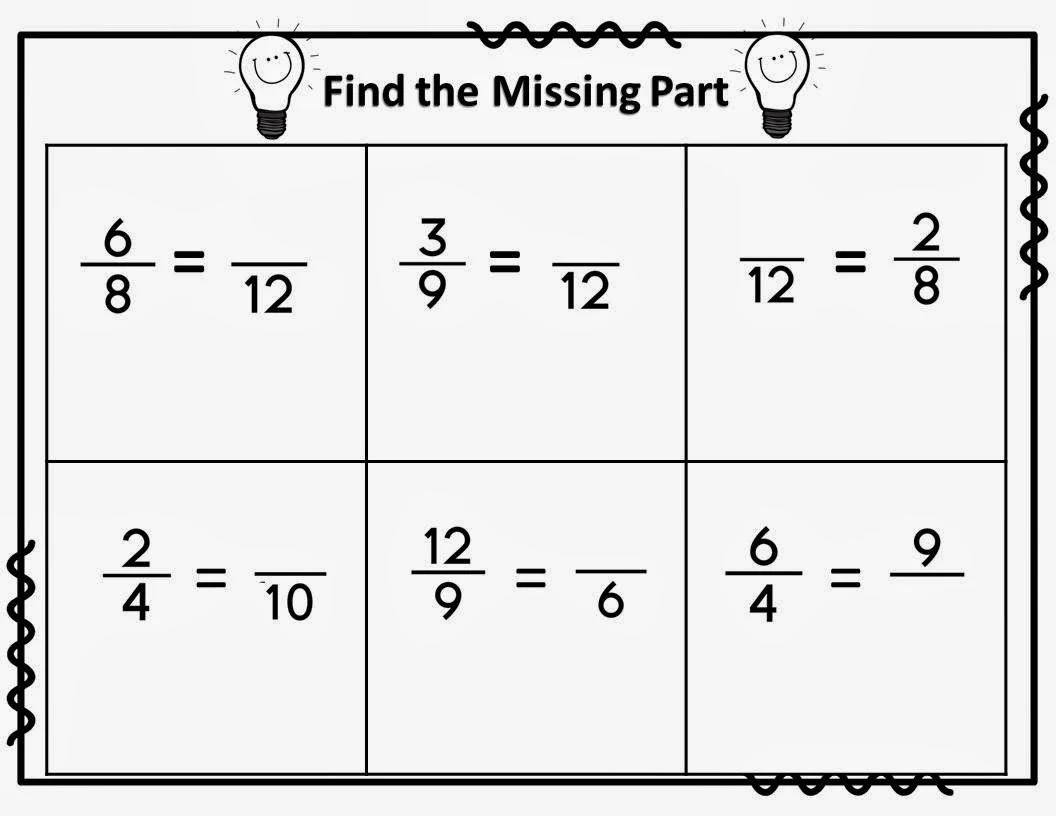
So, we decided to show students fractions where equivalency could not be simply determined by multiplying the numerator and the denominator by the same number. Students would have to reason and verify using the different math tools because the "rule" no longer worked. Check out the fractions below. Can you see how different thinking might be required using problems such as these? Click on the images if you would like to grab a freebie.
When students are working through these types of problems allow them to choose the type of math tool they want to use. Have students see different ways to defend thinking and multiple ways to show the fractions using the different manipulatives.
Subscribe to:
Posts (Atom)
Powered by Blogger.