Math has its own language, and if our students don’t know the words, they will struggle with the concepts. When I was in the classroom, I knew I had to be intentional about teaching math vocabulary because it’s not something our students pick up naturally in everyday conversations. In fact, if we heard them using math terms walking down the hallway, we'd probably take a quick double-take! Keep reading to learn more about the importance of teaching math vocabulary.
Pam's Place: Graphic Organizers
Showing posts with label Graphic Organizers. Show all posts
Summer Bloggin' ~ Week #3 FREEBIE
Welcome Back Wednesday. Today I am sharing a graphic organizer that can be used by students during and after reading. Not only do students have to identify character traits, they have to go back into the text to find the evidence.
Graphics: Creative Clips & Graphics From the Pond
aSometimes students will pick traits that they feel comfortable with, even if I give them a character list with some robust choices. So, depending on the readiness levels of my students, I may suggest a character trait or two that will challenge their thinking or make them look at the character through a certain lens.
Make the organizer interactive by projecting it onto a whiteboard. Have students go up to the board and complete the organizer. Other students then can see if they can add any new ideas. Just a different twist to make this a collaborative effort.
Don't forget to click on the image above to grab your FREEBIE and hop on back to The Teaching Tribune to see some other great resources.
A Bit of Reading
If you have visited my blog in the past, you might have noticed my posts covered topics in math. Have you visited my Pinterest boards? Now, there you will find nothing but math. I have over 4,000 followers and counting. Guess a lot of people like math! If you haven't checked it out...give it a try. You might find something you can use with your students!
The reality is, my world is not all math. I thought I would start sharing some reading ideas too. I recently have gotten into this phase of creating anchor mats for learning. I know anchor charts have a predominant place in many classrooms, but I like students to have their own that they can revisit throughout the year. I am a firm believer in recycling and revisiting key skills.
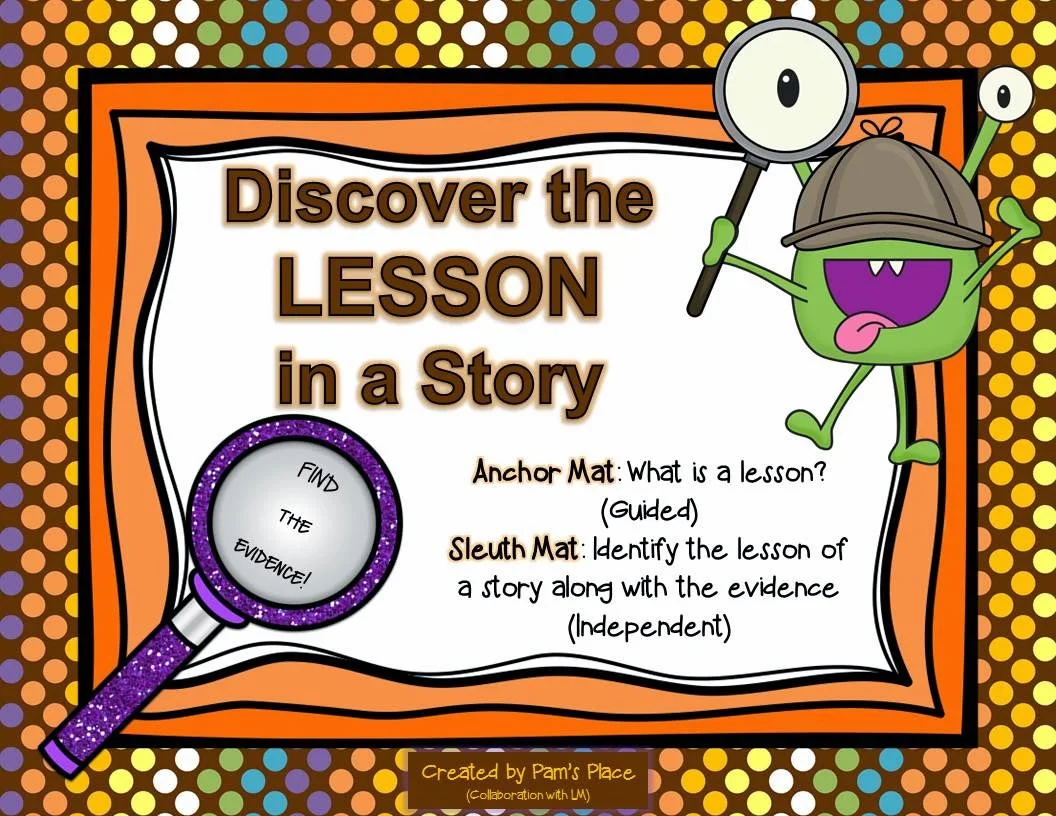
I recently uploaded a freebie in my TpT store to use when students are asked to find the lesson of a story. This skill is introduced to students in first grade with CCSS 1.RL.2 and continues to build in grades 2 (2.RL.2) and 3 (3.RL.2). By grade 4, students are asked to find the theme.
The anchor mat explores what a lesson is. Students can learn lessons in many different ways! The organizer can be used for students to record their thinking.
Some of the images on these pages are in color, but the pages can be printed in grayscale to save ink. Or students can put the pages into a plastic sleeve and use a wipe-off marker to respond. Or using a document camera, the pages can be projected onto a whiteboard. Students can respond on sticky notes and then add their sticky notes to each section. Students then can compare their ideas.
Click on the image above to view the download. If you give it a try, please leave feedback. I hearing and learning from others.
Graphic Organizers for Math Vocabulary
Graphic Organizers to Boost Vocabulary Understanding in the Math Classroom
Think graphic organizers are just for reading? They're actually perfect for building math vocabulary, too!! Math vocabulary can often feel abstract to students, but graphic organizers can help them visually connect definitions, visuals, and context for better understanding and retention of important words. Ready to give graphic organizers a try with your students? Try out these FREE printable graphic organizers for vocabulary.
3 Graphic Organizers to Use in the Math Classroom
1. The Frayer Model
The Frayer Model is an effective tool to help students develop a deeper understanding of key math concepts. It can be modified to fit different readiness levels, making it versatile for differentiated instruction. Depending on the focus of learning, the descriptors in the Frayer Model can be changed.After students become familiar with the Frayer Model, give them a blank template to add more engagement. Let students choose the descriptors that will help them best understand new math vocabulary. This encourages independent thinking and helps students recognize what is best for them as learners.
2. Concept Definition Map
A concept definition map guides students in understanding a math term through different lenses. By exploring a word through various perspectives such as "definition," "example," and "connections," students begin to build a more robust foundational understanding of the word. Students begin to see how words can be applied in different situations and make the words relevant to their experiences.
3. Connect 2: Finding Relationships Between Terms
The Connect Two strategy asks students to find relationships and associations between two math vocabulary words. This goes beyond defining each term and pushes students to think about connected concepts. Take two words from the math word wall and see if students can look beyond the literal definitions of these words. For example, students might connect the words "fraction" and "decimal" by discussing how they both represent parts of a whole.
For a challenge, why not have students try connecting three words? This can spark discussions about deeper connections and help students develop associations and see the interconnectedness of math vocabulary.
Words Walls: Visual Reinforcement of Math Vocabulary
Incorporating a math word wall in the classroom is another effective strategy for reinforcing math vocabulary. Word walls do not need to be static displays; they can be interactive and strategically organized to maximize student engagement and understanding. Displaying key terms, definitions, and visual aids reinforces the meaning, correct usage, and spelling of math vocabulary over time.Math word walls can be a valuable reference tool that students can interact with and use as they build math vocabulary and strengthen conceptual connections.
If you are looking for a resource with cards for a math word wall, click here: Math Vocabulary Cards.
Graphic Organizers: Tools for Understanding Vocabulary
Using a variety of graphic organizers can help students grasp a deeper understanding of math vocabulary. By sprinkling these ideas into your lessons, you provide students with tools to understand meanings, identify connections, and engage with vocabulary on a deeper level.
SAVE THIS POST FOR LATER:
Math Vocabulary: Graphic Organizers and Movement
Vocabulary in the math classroom can sometimes be challenging for students. The chart below shows how math vocabulary can be viewed through different lenses.
Math vocabulary can have multiple meanings. Think about the word gross. A math gross (noun) is very different than a gross (adjective) mess. Some vocabulary words are specific to math, so repeated exposure outside the math classroom might not happen often. Outside of the context of math, where have you seen the word algebra used? Whether through explicit or implicit instruction, students can benefit from vocabulary instruction that takes on multiple modalities.
When introducing math vocabulary, try using a graphic organizer. The Frayer model lends itself to differentiated math instruction and helps to represent words in more than one way. Click on the image to grab a copy. There are differentiated versions for the different learners in your classroom.
Learning can be enhanced by utilizing movement for instructional purposes. The movement increases sensory input to the brain. (Wolfe 2001) Try adding movement activities to teach and review math vocabulary. If you click the image below, you can find four ways to incorporate movement into the math classroom while teaching/reviewing vocabulary. These activities can be a "brain break" to get students up and moving while still learning! Use words that are part of your math word wall to review.
Subscribe to:
Posts (Atom)
Powered by Blogger.


.jpg)