Tapping into Multimodal Learning in the 21st Century

You’ve probably heard the classic V-A-K framework for years: visual, auditory, and kinesthetic learning styles. For so long, we were encouraged to pinpoint which style each of our students preferred and tailor instruction around that. Here we are in the 21st Century, teaching our kiddos who toggle between YouTube tutorials, fast-moving games, TikTok how-tos, and AI tools before the school bell even rings. Their brains are used to quick shifts, layered information, and a blend of senses happening at once. That means our teaching has to shift as well. That’s exactly where multimodal learning comes in.

Tap into multimodal learning and learn how you can take auditory, kinesthetic and visual learning into the 21st century.

Instead of focusing on which “type” of learner each student is, we now think about how many different ways we can help our students make sense of an idea. When instruction offers multiple modalities, what our students see, hear, say, build, sketch, write, model, or move, it opens doors for every learner. Multimodality isn’t about sorting our kids into categories. It’s about designing rich, flexible learning experiences that meet the reality of today’s diverse classrooms.


Why Multimodal Learning Matters in the 21st Century

Multimodal learning matters because Students today live in a sensory-rich world where visual and auditory information constantly overlap, interact, and compete for attention,
Students today live in a sensory-rich world where visual and auditory information constantly overlap, interact, and compete for attention. They swipe through videos, play interactive games, listen to podcasts, and use AI tools to explore new ideas, often at the speed of curiosity. When we bring multimodal learning into the classroom with that same intentional variety, it feels familiar to their brains. Purposeful shifts in how information is presented keep them alert, engaged, and mentally anchored in the lesson.


Modern classrooms also reflect a wide range of backgrounds and needs. We teach multilingual learners, students with unique neurological profiles, and children who arrive with very different levels of prior knowledge. When we lean into multimodality, we give each of our students an entry point into the same content. Rather than expecting everyone to learn in a single way, we create learning experiences that honor the idea that understanding grows stronger when it comes from multiple angles.


Using Visual Modalities to Support Multimodal Learning

Use visual modalities like this Eye on the Target poster to increase student understanding.
Visual thinking remains an incredibly powerful pathway for understanding, especially when it’s one part of a bigger multimodal plan. When your students can see an idea through illustrations, diagrams, color-coding, or sample models, abstract concepts suddenly feel more manageable. Visuals help your students build mental connections, find patterns, and remember information long after instruction ends.


Think about an image you may share with your students. A timeline in social studies, a visual cycle in science, or even a color-coded grammar example gives your students something concrete to connect with.

Using a visual cue, such as my Eye on the Target sticks, can help students visually walk through their assignments as they problem solve. It’s a simple example of how vocabulary and standards can be differentiated visually, but that exact approach can support so many different subjects. If you want to explore more visual supports for problem-solving, you can take a look at Eye on the Target for additional ideas.


Using Auditory Modalities as Part of Multimodal Learning

Auditory modalities like storytelling, read alouds and spoken explanations are powerful learning tools.
Even in our highly visual world, listening is still a powerful learning tool. Spoken explanations, read-alouds, storytelling, and partner discussions all help your students make sense of content in a way that feels conversational and human. When you introduce a new topic through a story, or when your students rehearse their thinking out loud, they strengthen their comprehension and build confidence before ever putting pencil to paper.

One of the easiest ways to integrate auditory learning is through picture books or oral storytelling. These moments bring emotion, pacing, and clarity to the content. If you teach customary measurement conversions, the Land of Gallon story is a great example of how a straightforward narrative can anchor understanding in a memorable way. The more your students hear language wrapped around concepts, the more naturally they begin to talk about and internalize those ideas themselves.


Using Kinesthetic Modalities to Build Meaning

These kinesthetic vocabulary supports will help you add kinesthetic modalities of learning to your lesson plans.
Movement is another essential layer of multimodal learning. Not because some of your students are labeled “kinesthetic learners,” but because physical engagement helps the brain connect ideas more deeply. When your students get up, manipulate objects, or interact with space, they build meaning in ways that worksheets alone just can’t replicate.


Human number lines are a wonderful example of kinesthetic learning. When your students physically step into the role of numbers, decimals, or rounding benchmarks, they suddenly understand the relationships between values much more clearly. "Build and compare" activities offer the same sense of discovery as your students use math tools, create models, and test their thinking with their hands. Vocabulary learning becomes more memorable when your students move between stations, act out words, or rotate through tasks that anchor meaning in both body and mind. If you’d like to try ready-made activities, make sure to grab a copy of the kinesthetic vocabulary supports.


Where Technology Fits into Multimodal Learning

Tech tools are great resources for targeting different learning styles in a way that appeals to students.
Technology has quickly become one of the most natural pathways for multimodality. Your students intuitively understand digital spaces. Tech tools give us endless ways to blend visuals, audio, movement, and interaction. Your student might watch a short video model, use voice tools to explain their thinking, collaborate inside a digital document, sketch on a touchscreen, or build a diagram using an online template. All of these experiences offer rich layers of input and output that make ideas more accessible.


As AI tools become part of daily life, they also open up new multimodal entry points. Your students might ask AI to summarize a concept, generate an illustration, check an explanation, or model a process. When used thoughtfully, these tools don’t replace learning. They expand the modalities available to your students, so they can choose the pathway that helps them understand the content most clearly.


Ready to Plan Multimodal Lessons With Ease?

Bring even more multimodal learning into your classroom with resources from my TPT store.
Ready to bring even more multimodal learning into your classroom? I’d love for you to explore the resources in my TPT store. Everything there is designed to help you plan lessons that naturally weave together different modalities so your students can interact with content in meaningful ways. From hands-on activities to visual supports and digital resources, you’ll find materials that make it easy to reach your diverse learners without adding extra stress to your planning time. 

A Modern Look at Learning Styles

Visual, auditory, and kinesthetic experiences still matter, but not because they define who our students are. They matter because learning becomes stronger when ideas are experienced from multiple directions. A modern classroom thrives when our students are invited to see, hear, discuss, sketch, model, build, imagine, act out, and explore concepts across multiple modalities.


The goal is no longer to match instruction to a preferred “style” but to design lessons that naturally weave together different modes of thinking. When our students access content through multimodal learning, they stay present, curious, and ready to participate. They also build a deeper and more durable understanding because they’ve interacted with the content in more than one meaningful way.


Save for Later

If you want to come back to these ideas when you’re planning future lessons, save this post now. Multimodal learning is one of those topics that becomes more powerful the more you play with it. Having these examples on hand makes it so much easier to weave multiple modalities into your day. 

Discover how combining visual, auditory, and hands-on strategies can boost student engagement and deepen understanding. This post explores practical ways teachers can support students using multimodal learning approaches that fit today’s classrooms. Perfect for educators looking to modernize instruction, reach all learning styles, and create meaningful learning experiences.


Math Framework for Differentiation

Differentiation in the math classroom requires some intentional planning to address the various readiness levels of students in the classroom. Here is a template to help create a canvas for differentiation for an upcoming unit or topic. By creating a framework, it allows students to enter learning at their level while ultimately having the goal to move students to a higher level of challenge. Click on the image below to download a copy.

https://app.box.com/s/en4nw6kmrkllyj4hufhc5e4s2t8onza6

Here is an example of a completed math framework. This example has many varied activities to address the different readiness levels of students. The goal is to pick and choose resources and ideas that keep the level of challenge appropriate. Recycling these skills throughout the school year by revisiting the framework can benefit students. After a unit, it is important to go back and reflect on what worked and what did not work. With each school year, the framework may need to be tweaked based on the readiness levels of students. Click on the image to grab a copy.

https://app.box.com/s/tp7d2twzvms62b7ekxf5axrwupwvr80u

To begin, start with the standards. It is important to integrate content standards and Standards for Mathematical Practice. By flipping the standards to "I Can..." statements, it makes them more accessible to students.

Keeping a pulse on student readiness helps drive differentiation throughout a unit or topic. It is important to identify that zone of proximal development for students where there is the right amount of challenge where learning takes place ~ not too easy, not too hard. To address student readiness levels consider varying the challenge for students and having students choose the "right fit" when completing problems.

Varying the challenge for students can be accomplished through "What's Your Path?" This structure is designed prior to a unit of instruction. To design a "What's Your Path?" for a unit consider your curricular resources and other supplemental materials that will provide the right amount of challenge for students. It is helpful to use preassessment data when crafting the paths. Based on student readiness, students can enter either Path A or Path B. Path A being the on level skill/standard; Path B allowing for the extension of a particular skill. The goal to keep in mind is that entering the paths is fluid for students based on readiness at any given time during a unit. Click on the image below to grab a copy.

https://app.box.com/s/7bcop8x8jpwiv4r30grd082igqva9xrj

Choosing the Right Fit is another way to address the various readiness levels of students in the classroom. When students are asked to problem solve simply remove the numbers and wa-la, you have created a differentiated task. The integrity of the math problem does not change. Only the numbers do. Differentiated sets of numbers can be added for students to then "choose the right fit." In this way, students have some control over the level of difficulty. Or, all numbers can be removed.  Students drive for understanding by choosing "right fit" numbers that they feel are an appropriate challenge for them. Sometimes when students select their own numbers, they may find that their chosen numbers will not necessarily work with the problem. What a great learning experience for them to discover!


Get to Know Students as Mathematicians

There are three student surveys teachers can use to help students understand themselves as mathematicians. Students fill in the bars based on their perception of each criterion.

Get to Know Students as Mathematicians

Getting to know your students as mathematicians and understanding their math identities can help you plan effective differentiation and create a classroom community that supports students in productive struggle. As teachers, we can gather data about our students through observations, class performance, and by asking students to reflect upon themselves as mathematicians and share their unique math identities. 

Surveys for Student Reflection

Here are three surveys students can complete to reflect on who they are as learners. Students shade the heights of the bars to represent how each criterion relates to them. Incorporating color and display elements can spotlight learners as mathematicians. This metacognitive reflection encourages students to create a voice and leave an imprint as learners. As teachers, we gain insight into their math identities and how we can best support them in the classroom.

1. My Math-o-Meter

Students can use My Math-o-Meter to rank their comfort level with each concept. It can highlight areas where students feel strong and areas where they may need more support.

My Math-o-Meter is a survey students fill in based on their perceived confidence in each of the concepts. Students will in the bars accordingly.

2. The Math Survey: Show What I Know in Math

This survey helps students reflect on how they best learn math. It can reveal whether students learn best through visual aids, hands-on activities, or verbal instructions. As teachers, we can tap into our aspiring mathematicians' learning styles and support them through math challenges with intentional teacher moves.
Math Survey on a clipboard for students to fill out based on ways they feel they are most confident with showing what they know in math.

3. MI Math Chart: To Show What I Know

The MI Math chart encourages students to reflect on and rate their learning preferences to demonstrate their understanding. This survey helps students identify their strengths across different intelligences, such as logical-mathematical, visual-spatial, and bodily-kinesthetic. Students become more aware of how they learn best, and teachers can offer multiple ways for students to access content to enhance learning.

This multiple intelligence survey is another option to have students reflect on ways they best show what they know.

Having students fill out these surveys at the beginning, middle, and end of the year can help them reflect on their growth and how they have evolved as learners. These surveys can also be shared with parents to help them understand their children's perception of themselves as learners. This can foster collaboration and home support. Click here if you want to try these surveys with your students.

Math Autobiographies

Have students reflect on their math experiences, the highlights and the challenges. Keeping the task open-ended allows students to express their thoughts in a manner that is natural to them. Have you ever written your own math autobiography to share with your students? Math autobiographies can be used to gain insights into students' perceptions about their journeys through math as you work to build a strong classroom community.

Journaling in Math

Have students reflect on the day's lesson or the content they are learning about. Try a 3-2-1 strategy where students jot down three things they learned, two connections they made to prior knowledge, and one challenge or question they encountered during the lesson. Changing up the prompts can help gain deeper insight. Keep journaling short and flexible to ensure it remains a manageable and meaningful task. 

Classroom Observations

Observe and document how students engage in discussions and group activities. Note whether they sit back and listen to others or if they dominate the discussions. Pay attention to their willingness to persevere when faced with challenges. Assess if they can support their classmates without simply giving away the answers. Monitor their willingness to take risks and make mistakes in math.

Students as Mathematicians Posters

These 12 colorful and inspiring mathematicians' posters are the perfect way to remind your students that they, too, ARE mathematicians. Plus, you will find four Math and Me interest and attitude inventories! Click the image to take a peek.

Color and black/white mathematicians posters to hang in the classroom to remind students they, too, are ALL mathematicians.

Understanding students as mathematicians is a dynamic process that involves student reflection, data gathering, and thoughtful application of collected insight. As teachers, we can meet students where they are at in ways that complement their unique mathematical backgrounds and experiences.

Quick Teacher Tips

Tricks of the Trade #1: Have you ever walked into your classroom after hanging posters and anchor charts on the wall to find them spewed across the floor the next day?!?! I have tried Blue Sticky Tack, duct tape, and hot glue. I.have.tried.EVERYTHING! Then Mavalus Tape came into my life. It is SIMPLY amazing! I purchased my roll of tape from a teacher supply store. It has made hanging items on my brick walls a breeze!


Tricks of the Trade #2: Using screenshots is an effective way for students to have accountability while using technology. Check out this web-based whiteboard. This is a creative way to use technology to have students show their footprints of thinking. Use this tool to have students show conceptual understanding in math or make quick sketches to represent thinking. There are other whiteboard tools that students can use online similarly. Have students use interactive math games online to review math skills and screenshot scores/performance. In this way, an accountability piece is embedded to help provide feedback regarding performance. High scores are a signal that students have grasped the concept. Low scores are a signal for possible remediation of skills.

A Few Ideas to Add to Your Writer's Toolbox

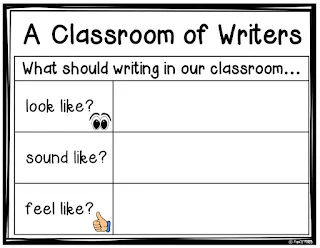
Do your students see themselves as writers? Do they think like writers? What do your students think a classroom of writers should look like? Set the stage for writing by creating an anchor chart with your students. Revisit throughout the year! Click on the image to download a FREE copy.

https://app.box.com/s/og0e0grj7j094yq77lp94fjtwhl00k6p

Some students are natural-born writers, and others are not. Some students LOVE to write, and others do not. In the end, all students should come to understand they ARE indeed writers!

Here are a few ideas that might work for your writer's toolbox:

Observe and Write:

The more information and ideas students have to write about, the more they will write. Activate student observation skills. Webcams are a great way for students to observe animals and places beyond the walls of their classrooms. Students can observe animals such as pandas, penguins, and apes or the Statue of Liberty and then write an informational piece or an opinion piece using the information they observed.

Check out these webcams:
San Diego Zoo-Animal Cams
Statue of Liberty-EarthCam

Check out the site, AirPano.com. Students can see 360-degree aerial panoramic views of over 200 locations on the planet. Let students "travel" to a location and then write about it. Students can convince others to visit a certain location or inform others about an interesting location.

Why are lemons sour? Why are school buses yellow? Wonderopolis is a site where students can find interesting questions and then watch a video and/or read some text to discover the answer. Students then can write an informative piece responding to the question.

Create Lists:

Lists can be a great motivator for reluctant writers. They are short and sweet, yet can be quite helpful to grow young writers. Creating lists can help writers maintain a focus. Given a topic for their lists, students should make sure that all ideas relate to the topic. Writing lists also can help create fluency in student writing. When students are asked to write lists, they can grow their own vocabulary and strengthen word associations. Lists are NOT the end. They are just the beginning. Students can use ideas generated from the lists for future writing tasks.

For example:
Make a list of items needed to make a scarecrow. (future how-to writing piece)
Make a list of fun fall activities. (future narrative piece)
Make a list of ideas you associate with the month of October.
Make a list of things you see mostly in the fall. (future informative piece)

Getting students excited about writing is important. We want our students to play with language and see that writing is connected and relevant to their lives.

Elaboration: 

One thing for students to keep in mind is that writing is never REALLY done. Revising is one step in the writing process where students can work to take their writing to the next level. Here is a quick idea to help students add to their writing. You can construct a chart similar to the one below. For each number, you can create different elaboration tasks. When students are "finished" with their writing piece or experience moments of writer's block, students can roll a number cube. Students then can match the roll with the elaboration task from the chart. This particular Roll-a-Cube chart is designed for narrative writing. How might the elaboration tasks change for informational writing? One idea is to have students add a statistic to their writing as evidence. Differentiate based on students' readiness levels.


Variety is the spice of life. By using a variety of ideas to hook and engage writers, we can help to grow young writers. Write on. . .

Land of Gallon - Customary Units of Measurement for Capacity

Introducing capacity measurement to learners can be challenging. To make this topic more accessible and memorable, we can integrate creative and interactive activities into our teaching approach. Using storytelling, we can transform the sometimes daunting task of learning measurement conversions into a whimsical tale.

In the Land of Gallon, there were four giant Queens.
Each Queen had a Prince and a Princess.
Each Prince and Princess had two children.
The two children were twins, and they were eight years old.

You can download the story and the pieces to use when telling it by clicking the image below.
https://app.box.com/s/e4n4pdu5d9ziu8jo7hzy9ztu2i0a1exh

Once students are familiar with the story be sure they see the connection between the story characters and the customary units of capacity measurement. If necessary, label the story pieces with their corresponding units of measure: queen = quart, prince/princess = pint, children = cups, 8 years old = 8 fluid ounces. You can reduce the number of customary units in the story based on student readiness. 

Be sure to explicitly show students how this story can help them to remember the following conversions:
4 quarts = 1 gallon
2 pints = 1 quart
2 cups = 1 pint
8 fluid ounces = 1 cup
8 pints = 1 gallon
16 cups = 1 gallon
128 fluid ounces = 1 gallon

You may have seen different versions of this story. Have students change it up to make it their own. Instead of the children being twins who were 8 years old, maybe they each had 8 toys or 8 frogs. Allow students to own the story by adding their own creativity.

Storytelling is one way to engage the brain during math class. "After a period of intense learning, storytelling enables the brain to relax and facilitates the retention of newly acquired material (Jensen 2000)." Give it a try!

Looking for additional reinforcement for capacity conversions? Click the image to check out these user-friendly task cards.

Equipping Students to Find Success with Word Problems

There’s something about word problems that can make even our strongest math students suddenly freeze. I’ve watched confident kiddos breeze through computation, only to stare blankly at a story problem that asks them to put those same skills to use. That disconnect is exactly why I started thinking more intentionally about how to help students notice, interpret, and truly make sense of the math hiding inside a context. Along the way, I created one of my favorite little tools, my "Eye on the Target" sticks. I quickly discovered how powerful they are for guiding students through the twists and turns of word problem solving.

Learn how to equip students to find success with word problems using these simple tools and strategies.

Why Word Problems Feel So Tricky for Students

If you’ve ever listened closely as your students work through word problems, you already know many aren’t struggling with the math. They’re struggling with the story. So often, the biggest roadblock isn’t addition, subtraction, multiplication, or division. It’s figuring out what the situation is actually asking. When our students feel unsure, they instinctively reach for shortcuts. They latch onto a keyword. They look for the first two numbers they can pluck out. They try to match patterns instead of understanding the problem. I used to see it happen all the time.


Word problems can often feel tricky to students due to readability, vocabulary and shortcuts students try to take when making meaning of word problems.
The problem is that shortcuts don’t always hold up. Keywords, especially, can mislead your students so quickly. For example, a phrase that is a perfect reminder of this is the phrase “in all,” which appears in both an addition problem and a multiplication problem. The situations require completely different operations. When your students rely on those shortcuts, they miss the heart of what the problem is asking. That’s why you want your students to step back, breathe, and say: "What do I notice? What is known? What is unknown? What makes sense here?" When you slow them down long enough to actually grapple with the meaning, their entire approach changes.


Another thing that gets in the way is readability and vocabulary. Even the most carefully written problems include words like product, foot, area, or gross. All of these carry both mathematical meaning and everyday meaning. When your students trip over vocabulary, they can lose the whole thread. Before they know it, they're solving something the story never asked. If your kiddos can understand the situation, they can handle the math.


Helping Students Make Sense of the Story Behind the Numbers

Tools like maniupulatives, mini whiteboards or even scrap paper can help them to make sense of word problems.
Supporting your students through word problems doesn’t have to feel overwhelming. One of the simplest shifts you can make is inviting your students to restate the gist of a problem in their own words. Ask your students, "If you had to tell a friend what’s happening in this problem, what would you say?" Their retellings instantly reveal whether they actually understand the scenario or if they’re grasping at parts without seeing the whole picture.


Another powerful move is having your students label what each number represents. Students can easily lose track of what each number means if they rush in without a plan. When your students write things like 12 = number of trays or 3 = cups per batch, the meaning of the numbers helps to make the story clearer. Multi-step tasks feel less overwhelming because your students can follow their own thinking trail.


There’s also modeling. Giving your students manipulatives, mini whiteboards, or even scrap paper to sketch the situation helps them visualize the math in a way that words alone can’t accomplish. I’ve had kids act out problems, use counters, draw array models, or create bar diagrams. All of these methods focus their thinking on what’s happening in the word problem, not just on what numbers appear.


Why Numberless Number Problems Belong in Your Classroom


Utilize problems without numbers to help students determine what the story is really about.
One of my favorite strategies for helping students make sense of math was removing the numbers altogether. Numberless word problems stop your students from diving headfirst into procedure mode. Without digits to latch onto, they have to slow down and think: "What is actually happening in this scenario?" This forces your students to build meaning before they ever compute. That’s exactly where deep understanding begins.


When your students engage with numberless problems, they notice structure. They think about relationships. They determine what the story is really about. Once they’ve built meaning, adding numbers back in becomes seamless. I loved watching my students realize, often for the first time, that the operations aren’t chosen because of a keyword. They’re chosen because of the action happening in the story.


This is such a powerful way to interrupt the habit of number plucking. Suddenly, their reasoning shifts from wondering what to do with the two numbers to understanding what’s happening. Once your students learn to read the situation instead of reading for a shortcut, everything changes. Their problem-solving improves. Their confidence grows. The math starts clicking.


A Visual Path Through Solving Word Problems

This image highlights the "Eyes on the Number Stick", a great visual tool to use when solving word problems.
I wanted a simple, concrete tool that would equip my students when they weren’t sure what to do next. The Eye on the Target sticks don’t tell your students how to solve the math. They guide them through the steps of thinking about the math. Every icon on the stick represents a part of the journey, starting with noticing, understanding, choosing a strategy, solving, and checking.

Since these sticks are familiar and friendly, your students won't feel embarrassed using them. They become a quiet form of support, helping your students build independence over time. The best part? They’re incredibly easy to make. All you need are jumbo colored sticks, wiggly eyes, and labels. 


Here's how to make these come to life for your classroom:

  • Print out the FREE document 
  • Cut along the grey outer edge
  • Wrap the paper around a jumbo colored popsicle stick
  • Glue on a wiggly eye


Your kiddos will absolutely love the wiggly eyes on top. You'll smile when you see them instinctively grab their stick the moment they feel stuck. Instead of saying, “I don’t get it,” they pause and look at the visual cues. It prompts them to slow down long enough to figure out where the breakdown is happening. Did they understand the story? Did they identify what’s known and unknown? Did they choose an operation based on the action, not a keyword? That reflection is where real progress happens.


Helping Build Independence with Visual Tools

Help build independence using visual tools like this math poster.
These sticks work best after your students have been introduced to the problem-solving icons and used them during guided practice. They are:
  • Underline the question
  • Identify key information 
  • Crossout our additional information 
  • Choose a strategy
  • Solve the problem
  • Check work 
Modeling what each of these steps means and what to do during each step is so important. Once they recognize each step and what it represents, the stick becomes a roadmap they can follow on their own. 

I recommend keeping a small bin of them accessible so your students can grab one during independent work without interrupting instruction.

What I loved about these sticks was that they worked for a variety of learners. Some of your students will benefit from more visual steps. Others will need the stick to be streamlined. You can add icons, remove icons, or customize them based on specific student needs in your room. They’re incredibly adaptable, which makes them a useful scaffold no matter where your students are in their problem-solving journey.

Pairing the sticks with a classroom poster is another great way to reinforce the steps visually. After introducing each icon, hang the poster where your students can reference it all year long. That consistency helps your kiddos internalize the mindset and process successful problem-solving.


Using Word Problem Mysteries to Build Problem Solvers

This taco truck mystery helps students build problem solving as they solve various word problems.
Once your students understand that meaning matters more than shortcuts, they’re ready for richer word-problem experiences. Ones that stretch their thinking and make problem-solving feel purposeful. This is exactly where my resources like the Taco Truck Math Mystery and Donut Truck Math Mystery shine.


In the Taco Truck Math Mystery, your students solve multi-step problems involving addition, subtraction, multiplication, and division. As they solve the problems, they eliminate suspects one clue at a time. Several clues require your students to track quantities across days, compare totals, and make sense of changing amounts. These are usually the spots where our students often lose track of what numbers represent. Instead of plucking numbers and hoping they choose the right operation, your students will benefit from walking through the steps on their Eye on the Target stick.


The Donut Truck Math Mystery pushes your students further into multiplication and division scenarios. Some problems use similar language but involve different operations. Your students will see firsthand why “in all” can’t be relied on as a shortcut and why thinking about the action in the story determines the math, not a single phrase. These clues give your students concrete opportunities to retell the scenario, sketch a plan, label the meaning of each number, and check their reasoning before solving.


Both resources give you ready-made, high-interest problems that naturally encourage good problem-solving habits. When your students work through them using the Eye on the Target stick, they have a visual guide that slows them down just enough to build thoughtful, precise reasoning. You can use the mysteries in small groups, math centers, partner activities, or whole class problem-solving days. They work best after modeling the steps on the stick. This way, your students are given immediate ways to apply the strategies in a meaningful context.


Try Out This Free Word Problem Resource

Try out this free making sense of word problems activity in your classroom.
If you're ready to help your students slow down, think deeply, and truly make sense of the math in front of them, I’ve got a free resource you’re going to love. I put together a Making Sense of Word Problems sampler that gives your students structured opportunities to notice what’s happening in a problem, identify what’s known and unknown, and build the kind of understanding that leads to confident, independent problem solvers.


You can use this resource while modeling to the class, working with small groups, or even as a warm-up to get your students thinking beyond shortcuts and into genuine sensemaking. It’s simple to use, easy to implement, and a great way to help your students look closely at the story behind the numbers.


Time to Rethink Our Approach to Word Problems

Rethink your approach to teaching word problems so students can build higher-thinking skills.
So often, our instinct is to simplify word problems to make them more accessible. What if you approached them from the opposite direction? Instead of breaking problems down, build problems up. Encourage your students to dig deeper, think critically, and stretch their reasoning. When your students engage with richer problems, act out scenarios, generate their own questions, or visualize the situation, they become stronger thinkers.


This shift helps your students build higher-order thinking skills and recognize that math isn’t just about finding an answer. It’s about understanding a situation. It’s about curiosity, flexibility, creativity, and perseverance. When your students experience that kind of problem-solving, their confidence soars. They feel capable. They feel empowered. They begin approaching each new problem with a sense of purpose.


Word problems don’t have to be intimidating. With the right tools, the right strategies, and the right mindset, your kiddos can become thoughtful, successful problem solvers who genuinely understand the math they’re doing. That, as teachers, is the kind of growth we love to see.


Save for Later

If you’re anything like me, you love having ideas you can come back to when you’re planning future units or refreshing your math block. Save this post to your favorite teaching board so you can revisit all of these strategies. These tools will be here waiting for you whenever you’re ready to boost your students’ confidence with word problems.

Equip your students to find success with word problems using these simple resources and strategies! This post will guide you through how to help students make sense of word problems amid struggles with vocabulary, keywords and problem readability.


post signature

Create Differentiated Objectives Using this Interactive Tool

Every student can learn just not on the same day or in the same way. ~George Evans

Here is a helpful way to generate differentiated objectives for students. The Differentiator by Byrdseed.com is an interactive tool with a bank of suggestions to create differentiated learning objectives using: Thinking Skills, Content, Resources, Products, and Groups.

http://byrdseed.com/differentiator/
by Byrdseed.com
This tool allows you to create objectives by differentiating...
  • Thinking Skills: Use different verbs from Bloom's Taxonomy.
  • Content: Focus on depth, complexity, imperatives (to increase student engagement), or key words. To bring in curricular content, you can click in the [click to edit] and type in curricular content.
  • Resources: Identify whether you want students to use print copies of resources or online resources.
  • Products: Choose products based on students learning styles: visual, construction (hands on), oral, multimedia, or written.
  • Groups: Decide if students will work independently, in partners, in triads, or groups of 4.
This tool can help when trying to ensure there are multiple entry points of learning for students of different readiness levels and different learning styles. The depth of the objective drives for deeper learning. It also is a springboard for a variety of ideas. How might this work with having students take a part in creating the way the learning of the objective will be demonstrated? Once the objective is created, it can be copied into other documents. 

When creating a differentiated lesson for students in any content area this tool might be helpful.

post signature

Engagement 3D Style

Looking for a way to engage students?! How about adding anaglyph 3D images into your lessons? Doing a study on planets? Embed some 3D images into the lesson. When you look at the image below, it looks like an ordinary image with some different coloration in spots.

www.flickr.com

So where is the 3D, you ask? How do you make it a 3D experience? Students will need paper 3D glasses. These glasses can be purchased online. You can shop around for reasonable prices. When students view the image above with 3D glasses, Earth "pops" out of the page. So cool!


Where do you find 3D images? You can search the Internet by typing: anaglyph images and videos. Anaglyph images can only be seen as 3D images if these glasses are worn.

If you create review games for students using PowerPoint, correct answers can be rewarded with 3D images. Pick a theme of images and hook students into reviewing. Students will work really hard to get correct answers in anticipation of the next 3D image that will pop up.
 
It is exciting! It is engaging! What are some strategies you use to engage students?

post signature

Lucky 13 and Language Skills Too

Happy Friday the 13th! Are you someone that thinks the number 13 is lucky or unlucky? Did you know that paraskevidekatriaphobia is the fear of Friday the 13th? Well, today let's view 13 as lucky!

13 Good Luck Symbols

-a four-leaf clover (Did you ever find one?)
-a lucky horseshoe
-a rabbit's foot
-a penny (See a penny, pick it up, and all day long, you will have good luck!)
-a wishbone
-a rainbow
-a ladybug
-a "shooting" star
-sapphires
-lucky bamboo
-the number 7
-three keys (Unlock the door to health, wealth, and love.)
-fuzzy dice 

Which of these symbols do you consider to be lucky?

Looking for a fun way to review language skills like similes, multiple-meaning words, dialogue with quotes, exaggeration, comparisons, and imagery with short writing tasks. A little prep work in creating the cubes is required, but then let the creative juices flow!! Students can complete the tasks in small groups, as independent work at a writing center, or as a whole class activity where students share their ideas!


Thanks for stopping by Pam's Place.

post signature

Written Communication in the Math Classroom

How do you encourage student writing in the math classroom? When students are asked to write, it stretches their thinking. It encourages students to reason about a math concept/skill while stepping away from simply performing a procedure to get an answer.

Think about it. Writing gives a voice to every student. How powerful is that?! Consider writing open-ended questions with multiple entry points when creating prompts and/or questions for students to respond to. In this way, all students have access to the task. Keep them short. Consider the following: Recap today's lesson. Can you say it in 6 words? Think about how selective students will need to be in choosing their words. With a quick glance, you can see which students got the gist of the lesson. Purposeful questions foster students' reasoning of mathematical concepts.


Check out the math prompts and questions you can use with your students. The math prompts and questions are designed for any math topic. You can use them for journal writing or as exit tickets. For journal writing, students can attach the prompt or stem in their math journal and respond at the end of class. In this way, students are given time to reflect upon the day's lesson and think about their thinking.

Or, use the math prompts/questions as exit tickets. Exit tickets set an expectation that students need to be actively involved during the lesson to be able to demonstrate their understanding in a thoughtful way. Students can be given time at the end of the class period to synthesize the day's lesson by completing an exit ticket. Once the exit tickets are turned in, information can be gathered to guide instruction the next day.

Powered by Blogger.